IMPORTANT DISCLAIMER: This guide references NFPA 101, Life Safety Code (Assembly Occupancies, Chapters 12 and 13); NFPA 1, Fire Code; NFPA 13, Standard for the Installation of Sprinkler Systems; NFPA 72, National Fire Alarm and Signaling Code; NFPA 96, Standard for Ventilation Control and Fire Protection of Commercial Cooking Operations; NFPA 17A, Standard for Wet Chemical Extinguishing Systems; NFPA 914, Code for Fire Protection of Historic Structures, where applicable to historic worship buildings; and the International Fire Code (IFC) and International Building Code (IBC). These codes vary significantly by edition and are frequently amended by state and local jurisdictions. NFPA 101 editions include 2018, 2021, and 2024, with a 2027 edition in development. The most recent published edition is NFPA 101 (2024), but AHJ-adopted editions commonly lag behind by one or more cycles. Jurisdictions typically adopt either the NFPA family or the ICC family of codes—requirements for the same building can differ between the two. Local amendments and the edition adopted by your Authority Having Jurisdiction (AHJ) always control. This guide is a starting point only—always verify the specific requirements applicable to your project with your local AHJ.
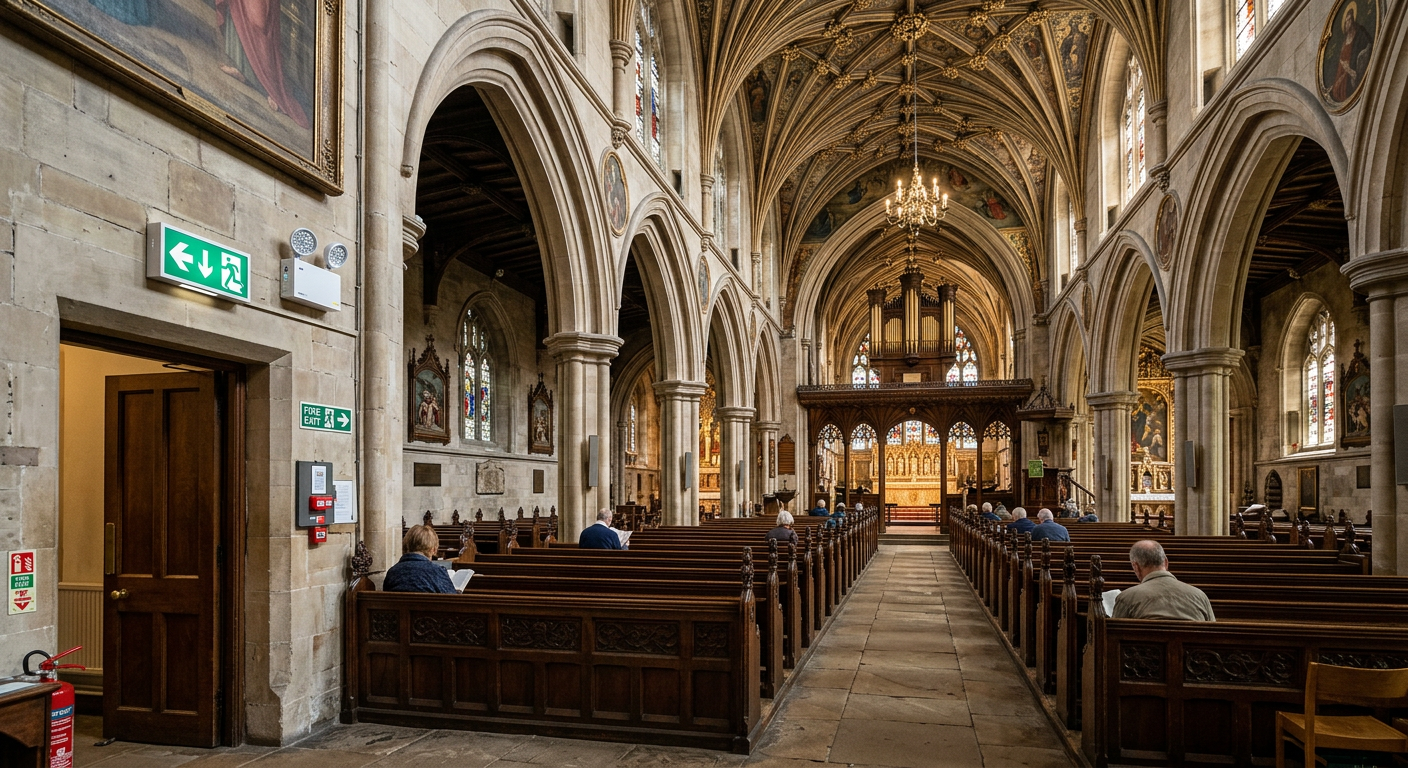
Places of worship occupy a unique position in fire safety. They are assembly occupancies under NFPA 101, which places them in the same broad category as theaters, stadiums, and auditoriums—though the specific requirements scale with occupant load, seating type, and other triggers. Yet they are often volunteer-run, historically significant, and irregularly occupied—used intensely during services and holidays, then empty for days.
That combination creates predictable failure modes. Exit doors get chained for security. Decorations obstruct sprinkler heads. Candles are used without noncombustible bases. Fire alarm systems develop trouble conditions that staff silence rather than repair. Volunteers who usher or run the sound system have never been trained on evacuation.
The 2019 Notre-Dame Cathedral fire was a global wake-up call. It demonstrated that even iconic, heavily visited worship buildings can have gaps in fire detection, suppression, and emergency planning. The fire was detected but misinterpreted—the system alarmed, but the guard was sent to the wrong location after the first signal, and the fire was confirmed only after a second alarm roughly 20 minutes later.
This guide covers the fire safety challenges of places of worship and the practical solutions for protecting them.
◆ Section 1: Why Places of Worship Are Different
Places of worship present fire safety challenges that differ from other assembly occupancies.
| Factor | Challenge |
|---|---|
| Volunteer staff | Ushers, sound operators, and clergy may have no fire safety training |
| Irregular occupancy | Empty for days, then full for services and holidays |
| Fixed seating | Pews and benches create egress challenges and often predate current codes |
| Open flames | Candles, incense, and ceremonial fires are integral to worship |
| Historic construction | Older buildings often have combustible materials, open stairways, and limited egress |
| Security vs. egress conflict | Locked doors for security directly conflict with life safety |
| Decorations | Seasonal decorations obstruct sprinkler heads and exits |
| High holiday loads | Attendance can spike far above normal weekly services |
Key point: The core challenge in places of worship is not the absence of systems—it is the gap between systems and people. A sprinkler system that works is useless if decorations block the heads. An alarm that sounds is useless if no one knows what to do.
Pro Tip: Walk through your building as if you were a first-time visitor during a service. Can you find the exits? Are they clearly marked? Are they unobstructed? If you cannot, your congregants cannot either.
◆ Section 2: Occupancy Classification and Occupant Load
Places of religious worship are classified as Assembly Occupancies under NFPA 101. This applies regardless of the specific faith tradition.
A. The 50-Person Threshold
An assembly occupancy is defined as a space designed for the gathering of 50 or more persons for purposes including worship, entertainment, or deliberation . Facilities designed for fewer than 50 may fall under a different occupancy classification.
B. Occupant Load Factors
Occupant load is calculated based on the seating configuration :
| Seating Type | Occupant Load Factor | Basis |
|---|---|---|
| Fixed seating | Number of fixed seats installed | N/A |
| Pews and bench-type seating | 1 person per 18 linear inches | Linear measurement |
| Areas of concentrated use (without fixed seating) | 7 sq ft per person | Net |
| Less concentrated use | 15 sq ft per person | Net |
| Waiting space | 3 sq ft per person | Net |
Key point: Required aisle space serving fixed seats shall not be used to increase the occupant load. The number is based on the seats themselves, not the floor area around them.
Key Article: Article 34 — How to Determine Occupant Load (NFPA 101 Table 7.3.1.2)
C. Occupant Load Posting
Where required by the AHJ or code edition, the occupant load must be posted in a conspicuous location. Posting serves two purposes: it tells staff the maximum capacity, and it gives fire inspectors a baseline for enforcement. Verify whether posting is required in your jurisdiction and, if so, where the sign must be located.
D. Life Safety Evaluations
For assembly occupancies with occupant loads exceeding 6,000 persons, a life safety evaluation by approved personnel is required . This is rare for most worship buildings but applies to major cathedrals and megachurches.
Pro Tip: If your building can hold more than 6,000 people, the life safety evaluation is not optional. It must assess building systems, facility management, and emergency procedures.
◆ Section 3: Egress in Fixed-Seating Assembly Spaces
Fixed seating—pews, benches, and theater-style seats—creates specific egress requirements.
A. Secured vs. Unsecured Seating
| Seating Type | Requirement |
|---|---|
| Secured seating (more than 200 persons) | Seats shall be securely fastened to the floor, unless fastened together in groups of at least 3 |
| Unsecured seating | Permitted only where fastening is impracticable, with adequate aisles maintained |
Key point: Pews bolted to the floor are not a problem. Pews that can shift and block aisles during an evacuation are.
B. Aisle and Row Requirements
These figures vary by edition and code; use the ones in your adopted edition. The core principles:
Aisles must lead to exits, cross aisles, or foyers
A maximum number of seats is permitted between any seat and the nearest aisle
Dead-end aisles are limited in length
Aisles must be kept clear at all times
Important: The specific figures—maximum seats between aisles, maximum dead-end length, minimum aisle width—differ between NFPA 101 editions and between NFPA 101 and the IBC. Pull the applicable figures from your AHJ-adopted edition.
Key Article: Article 38 — Corridor Width, Door Clear Width, and Stair Dimensions
C. Exit Door Hardware
Exit doors in assembly occupancies must be openable from the inside without a key, special knowledge, or effort during any time the space is occupied. Panic hardware or fire exit hardware is required where the occupant load meets the applicable threshold.
Threshold note: NFPA 101 requires panic hardware for assembly occupancies with an occupant load of 100 or more . The IBC requires it for Group A occupancies with an occupant load of 50 or more . Verify which code your jurisdiction has adopted.
The Locked Door Problem: The practice of chaining or padlocking exit doors to control entry during services is a code violation that creates a serious life safety hazard. Hardware that allows doors to be secured against exterior entry while remaining operable from the inside satisfies both security and egress needs.
Pro Tip: Walk to every exit door in your building during a service and try to open it from the inside. If you cannot open it without a key or special knowledge, it is a violation that must be corrected before the next service.
◆ Section 4: Candle, Incense, and Open Flame Management
Open flames are integral to many worship traditions. NFPA 101 permits them under specific conditions.
A. When Open Flames Are Permitted
Open flame devices are permitted in assembly occupancies under the following circumstances:
| Permitted Use | Condition |
|---|---|
| Ceremonial or religious purposes | Precautions satisfactory to the AHJ to prevent ignition of combustibles or injury to occupants |
| On stages and platforms | As a necessary part of a performance |
| On tables | Candle securely supported on a substantial noncombustible base; flame protected |
| Food preparation | Per food service operations provisions |
B. Decorative Candles (IFC Requirements)
Where decorative candles are used, IFC 308.3.1 provides specific requirements for open-flame decorative devices :
| Requirement | Specification |
|---|---|
| Fuel type | Class I and Class II liquids shall not be used |
| Self-extinguishing | Devices with more than 8 oz. of fuel must self-extinguish if tipped |
| Spill prevention | Devices must prevent spillage of liquid fuel or wax |
| Return to upright | Devices must return upright after tilting to 45 degrees |
| Flame enclosure | Flame must be enclosed with specific exceptions |
| Candelabras | Securely fastened in place; located away from occupants and combustibles |
Note: These IFC requirements apply in jurisdictions that adopt the ICC family of codes. If your jurisdiction adopts NFPA 1, verify the equivalent provisions in that code.
Pro Tip: If your tradition uses candles, invest in noncombustible bases and enclosed flames. The difference in risk between an open candle on a wooden pew and a protected candle on a metal base is significant.
C. Handheld Candles and Candlelight Services
Candlelight services—where congregants hold lit candles—raise a specific question: are handheld candles permitted? The answer depends on your AHJ and the specific conditions of use. Some jurisdictions interpret the code restrictively for handheld candles in seating areas, while others permit them with precautions (noncombustible drip guards, spacing, and supervision). Confirm your AHJ’s position before planning a candlelight service, and be prepared to demonstrate how you will prevent ignition of clothing, hair, and combustibles.
Key Article: Article 46 — Hazard Classification (Low, Ordinary, High) and Hazardous Areas
◆ Section 5: Historic Worship Buildings
Many places of worship are historic structures. The fire safety challenges of historic buildings—discussed in detail in Article 96—apply directly.
| Historic Challenge | Impact on Worship Buildings |
|---|---|
| Combustible construction | Heavy timber roofs, wood framing, historic finishes |
| Open stairways | Grand staircases that act as chimneys |
| Limited egress | Narrow corridors, single exits |
| Outdated systems | Old electrical wiring, no sprinklers |
| Preservation constraints | Alterations may be restricted |
The Notre-Dame Lesson: The fire at Notre-Dame Cathedral demonstrated that historic worship buildings can have detection systems whose signals are misinterpreted, staff who are not trained on system response, and suppression that does not cover the highest-risk areas (the attic had no sprinklers). The system functioned; the human response to it did not.
Key Article: Article 96 — Fire Safety for Historic Buildings: Challenges and Solutions
Pro Tip: If your worship building is historic, do not assume that “it has stood for a hundred years” means it is safe. The materials that survived for a century are the same materials that will burn.
◆ Section 6: Fire Alarm and Detection
Fire alarm requirements for assembly occupancies apply to places of worship, with specific thresholds.
A. When a Fire Alarm System Is Required
NFPA 101 requires a fire alarm system for assembly occupancies with occupant loads of more than 300 . This is the threshold for the fire alarm system itself—detection and notification by audible and visual appliances.
B. When Voice Notification Is Required
The emergency voice/alarm communication system requirement is separate from the fire alarm system threshold and is typically triggered at a higher occupant load. The IBC’s voice-alarm threshold for assembly occupancies is significantly higher than the NFPA 101 fire alarm threshold. Verify the specific trigger for voice systems against the code edition adopted by your jurisdiction.
For large sanctuaries where music, amplified speaking, or other activities create high ambient noise levels, notification appliances must produce sound levels that exceed the ambient level by the margin required by NFPA 72. Visual strobe devices throughout the worship space ensure notification reaches all occupants.
C. Inspection, Testing, and Maintenance (ITM)
The fire alarm system must be inspected, tested, and maintained under NFPA 72. Most components require annual testing, but some components require semiannual testing. ITM must be conducted by certified or qualified personnel. Verify the applicable frequencies against your adopted edition.
D. Common Alarm Problems
The most common fire alarm problems found during inspections include:
Persistent trouble conditions that have been silenced by staff rather than repaired
Systems that have not been tested annually
Notification that does not reach all areas
Pro Tip: A silenced trouble condition is not a repaired trouble condition. If your alarm panel shows a trouble light, it needs attention.
◆ Section 7: Suppression for Worship Spaces
Suppression requirements depend on the building’s age, size, construction type, and the specific triggers in the adopted code.
A. Sprinkler Systems
Sprinklers are not required in every worship building. Whether they are required depends on several categories of triggers:
Occupant load of the assembly space
Fire area size
Floor level relative to the level of exit discharge
Stage or exhibit use
The specific thresholds for each of these triggers differ between NFPA 101 and the IBC, and between editions. If your building predates current requirements, significant additions, renovations, or changes of occupancy often trigger a requirement to bring the affected portion into compliance. Verify the applicable triggers against the code adopted by your jurisdiction.
B. Decorative Obstructions
Worship spaces are frequently decorated with hanging fabric, banners, seasonal decorations, and floral arrangements. The 18-inch clearance below sprinkler deflectors is the storage clearance rule from NFPA 13 and IFC storage provisions. It is applied to decorations by extension—and obstruction rules also apply regardless of the specific 18-inch figure. Any object that blocks the spray pattern of a sprinkler head reduces coverage and violates the intent of the installation standard.
Pro Tip: Train staff and volunteers to identify and avoid sprinkler head obstruction zones when hanging decorations. This is especially critical during major religious holidays when sanctuaries are most heavily decorated and most heavily occupied.
C. Fellowship Kitchens
Houses of worship with commercial kitchens require suppression under NFPA 96, installed per NFPA 17A. NFPA 96 is the standard for commercial cooking operations; NFPA 17A is the installation standard for wet chemical extinguishing systems. Kitchens with commercial cooking equipment that produces grease-laden vapors fall under these requirements.
Key Article: Article 115 — Kitchen Hood Suppression Systems (NFPA 96)
D. Portable Extinguishers
Fire extinguishers should be placed in accessible locations, including near exits, kitchens, and areas with open flames. In fellowship kitchens with commercial cooking equipment, Class K extinguishers are required at cooking appliances that use vegetable or animal oils and fats, per NFPA 10.
◆ Section 8: Volunteer Staff Training and Fire Drills
This is where places of worship most often fail—and where improvement is easiest.
A. Training Requirements
Employees and attendants of assembly occupancies shall be trained and drilled in the duties they are to perform in case of fire or other emergency. Ushers, sound operators, and clergy fall into this category.
Training should cover:
Fire alarm and evacuation signals
Assigned duties in the event of an alarm
Evacuation routes
Areas of refuge
Exterior assembly areas
Procedures for evacuation
B. Fire Drill Frequency
NFPA 101 requires staff to be trained and drilled in their duties but does not set a specific frequency for full congregation evacuation drills. The requirement is about staff preparedness, not a mandated evacuation drill schedule. Many jurisdictions, however, require annual drills for assembly occupancies as a matter of local policy or AHJ practice. Confirm your jurisdiction’s requirements.
Key point: Unannounced drills are a best practice—not a code requirement—and are recommended at least once per year to simulate unusual conditions rather than rehearse a known script.
C. Drill Conduct
When conducting drills:
Emphasis should be placed on orderly evacuation rather than speed
Drills should be held at expected and unexpected times and under varying conditions
Participants should relocate to a predetermined location and remain until a recall signal is given
Pro Tip: If your congregation has never conducted a fire drill, start with a simple one: after a service, ask everyone to evacuate as if there were a fire. Do not time it. Do not judge it. Just do it. The first drill is always the most educational.
◆ Section 9: Portable Heaters and Electrical Hazards
Portable space heaters and aging electrical systems are common causes of fires in worship buildings, particularly in older structures with limited or outdated wiring. NFPA analysis of religious property fires identifies heating equipment as a leading cause, particularly in December and January .
Use only listed portable heaters with automatic tip-over shutoff, keep them at least three feet from anything that can burn, and never use extension cords as permanent wiring . Have the building’s electrical system evaluated periodically, especially in historic buildings with original wiring.
◆ Section 10: Design Checklist for Places of Worship
| Item | Status | Notes |
|---|---|---|
| Occupancy classification | ☐ | Assembly if designed for 50+ persons |
| Occupant load calculated | ☐ | Based on fixed seats, pews, or net floor area |
| Occupant load posted | ☐ | Where required by AHJ or code |
| Exit doors openable from inside | ☐ | No keys, special knowledge, or effort required |
| Panic hardware where required | ☐ | NFPA 101: ≥100; IBC: ≥50 for Group A |
| Aisles clear | ☐ | No storage or obstructions |
| Open flame precautions | ☐ | Noncombustible bases; protected flames; AHJ-approved |
| Flame-retardant decorations | ☐ | Where required; especially at holidays |
| Sprinkler head clearance | ☐ | 18 inches clear of decorations |
| Fire alarm system functional | ☐ | Required where occupant load >300 per NFPA 101 |
| Voice/alarm system (if required) | ☐ | Verify threshold against adopted code |
| Alarm audibility/visibility | ☐ | Exceeds ambient noise; strobes in all areas |
| Kitchen hood suppression | ☐ | NFPA 96 / NFPA 17A if commercial cooking present |
| Class K extinguishers | ☐ | At cooking appliances using oils/fats |
| Emergency lighting | ☐ | Automatic activation on power loss |
| Exit signs | ☐ | Visible, illuminated, and unobstructed |
| Portable heaters | ☐ | Listed; tip-over shutoff; 3 ft clear of combustibles |
| Staff trained and drilled | ☐ | Per NFPA 101; evacuation drill frequency per AHJ |
| Historic building protections | ☐ | If applicable; see Article 96 |
| Pre-incident planning | ☐ | Coordinate with fire service |
◆ Section 11: Common Mistakes and How to Avoid Them
| Mistake | Why It’s a Problem | How to Fix |
|---|---|---|
| Locking exit doors for security | Violates egress requirements; mass casualty risk | Use hardware that allows inside operation while securing outside |
| Obstructing sprinkler heads with decorations | Reduces water coverage | Train staff on 18-inch clearance rule |
| Silencing fire alarm trouble conditions | System may not function when needed | Repair trouble conditions promptly |
| No fire drills | Occupants don’t know what to do | Conduct drills; frequency per AHJ |
| Untrained ushers and volunteers | No one knows evacuation procedures | Train all staff and attendants |
| Candle hazards | Open flames near combustibles | Use noncombustible bases; protect flames |
| Ignoring kitchen hood suppression | Grease fire risk in fellowship kitchens | Install NFPA 96 / NFPA 17A suppression; provide Class K extinguishers |
| Assuming historic buildings are safe | Age does not equal fire safety | Conduct fire risk assessment; see Article 96 |
| Using portable heaters improperly | Common cause of church fires | Use listed heaters; keep 3 ft clear; no permanent extension cords |
◆ Section 12: Conclusion
Places of worship face a unique combination of challenges: they are assembly occupancies with high occupant loads, often in historic buildings, run by volunteers, with open flames as part of worship. The systems and the people must work together—and too often, one or both fail.
Key Takeaways:
Places of worship are assembly occupancies—subject to the assembly chapter of NFPA 101, with requirements scaled by occupant load, seating type, floor level, and other triggers.
Exit doors must be openable from the inside without keys or special knowledge.
Panic hardware thresholds differ by code—NFPA 101 at occupant load ≥100; IBC at ≥50 for Group A.
Candles and open flames are permitted for religious purposes with specific precautions.
Sprinkler head clearance is 18 inches—per NFPA 13 and IFC storage rules.
A fire alarm system is required where occupant load exceeds 300 per NFPA 101; voice/alarm thresholds differ and should be verified against the adopted code.
Staff must be trained and drilled on emergency procedures; NFPA 101 does not set a drill frequency, but many AHJs require annual drills.
Historic worship buildings face additional challenges—see Article 96.
The Notre-Dame fire demonstrated that even iconic buildings can have gaps in detection, suppression, and planning—and that detection without correct interpretation fails.
Take Action Today:
Walk to every exit door and confirm it opens from the inside.
Check that decorations are at least 18 inches from sprinkler heads.
Verify your fire alarm panel has no silenced trouble conditions.
Conduct a fire drill after your next service.
Train ushers, sound operators, and clergy on evacuation procedures.
Confirm candle bases are noncombustible and flames are protected; check AHJ guidance on handheld candles.
If you have a commercial kitchen, verify NFPA 96 / NFPA 17A suppression is present and maintained, and that Class K extinguishers are available.
Check portable heaters for listing, tip-over shutoff, and three-foot clearance from combustibles.
Coordinate with your fire service for pre-incident planning.